Christoph
Friedrich Nicolai (1733-1811) 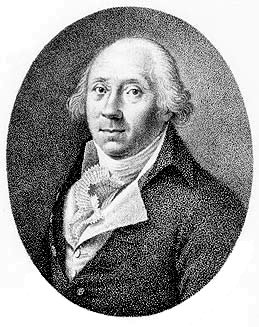
Friedrich
Nicolai:
Description of a journey through Germany and Switzerland, written in the year 1781,
Volume IV, Berlin
and Stettin
1785, Pg. 401 et seq.:
The most peculiar artist was without
a doubt Franz Xaver Messerschmidt 1), who subsequently died in August of 1783 in his 51st year.
He was a Schwabian born in Wiesensteig not far from Dillingen. This
man was noteworthy as an artist and as a human being. He was a man of
uncommon strength in mind and in body. He was an extraordinary genius
in his art while his personal life tended to be peculiar, primarily because
of his love of independence. He aimed to have few wants, loved nothing
but his art and was much accomplished in that. He possessed a vivid
imagination and a swift hand with which he made his thoughts come real.
He just observed nature and derived his work virtually without any other instruction.
After living in several South-German cities he headed for Rome
in his 33rd year. Here he attracted the attention of all
the other students that studied there and he managed to attain the friendship
of the most gifted ones among them; I learned this from artists who studied
there at the same time. His peculiarities were already apparent then.
Young painters and sculptors that rejoice in the benefit of pensions from
the great courts make a spectacle of themselves there at the monuments, many
use cumbersome apparatus and with great difficulty, using equipment the size
of which is often inversely proportional to the artists talents.
Messerschmidt was exactly the
opposite. He lived and dressed like an ordinary citizen. When
he began his studies in Rome
he bought a trunk of a lime tree and lugged it into the Farnesi palace where
he put it down in front of the Hercules statue. Two Spanish sculptors
living of their courtly pensions dressed in their fashionable morning negligee’s
while mucking about with their measuring devices and clay models looked over
their shoulders at the German stranger with the shabby clothes and short hair
and rather thought him to be a day laborer. Messerschmidt set to work
with a few carving knives and whittling the wood away this way and that.
The other artists watched him and particularly the Spaniards shrugged their
shoulders thinking that nothing good can come of such activity. Their
mockery soon turned to astonishment when they saw a beautiful Hercules emerge
from the unwieldy trunk. The Spaniards who had never been instructed
in this approach thought that this must have been accomplished with the help
of evil spirits, one of them made utterances to that effect. Messerschmidt
who was always a bit brusque, slapped one man (who was not particularly liked
by his fellow students anyway) for making such assertions and thus asserted
his place with honor, giving him a new status among his peers.
He returned to Vienna
where he held a position at the academy teaching sculpture around about 1768.
All academies are cesspools of petty squabbles and intrigues. In Vienna
it was customary to bow deeply before the assorted directors and functionaries
of the academic senate 2) and to cow tow to them in humble deference. This was not a good
thing to Messerschmidt who did not respect any of his competition as having
anywhere near his abilities. He complained bitterly about the many injustices
and chicaneries that had been perpetrated on him. I shall not further
expound on this; enough. After a while Messerschmidt sold all his artworks,
drawings, engravings, books and other possessions and moved to Pressburg where
he settled in a suburb named Zuckermandl 3) he bought a house there, right close to the
Danube. He lived there, supporting himself mostly with simple works 4) that were commissioned from him, he led a simple existence with few
frills, but a happy one. I found him there in his isolated house strong
in body and happy in his composure. He came across as an open and uncomplicated
character and we soon established a good rapport especially since I had brought
a letter of introduction from an artist whom he had known well while in Rome.
His entire furnishings consisted of a bed, a flute a tobacco-pipe and an Italian
book about human proportions. This was all that he wished to keep of
all his previous possessions. Aside from that there was a drawing of
an Egyptian statue without arms on half a sheet of paper hanging near the
window. He never looked at this drawing without reverence and awe. This
was at the core of Messerschmidt's foolery with which he drove to a remarkable
height and which gave him endurance and incredibility. It is clear from
other examples what a steadfast character combined with diligence and obsession
and a love for isolation can ultimately bring forth.
Messerschmidt was a man
with
driving passions, yet he had a need for solitude. He was
incapable
of doing injustice to another beings but suffered deeply from injustice
done to him. This affected his character severely, yet he didn't
let it disturb his generally happy disposition.
He lived for his art and was quite
ignorant of other things that didn't belong to the arts, even though he had
the ability to learn a multitude of things and was quite eager to learn.
In Vienna he fell into the company
of some people who boasted secret knowledge of dealings with invisible spirits
and the mastery over the forces of nature. These kinds of people are
very prolific in Europe and especially when operating in Germany they cripple
the minds of a great many and exercise power over them in the employ of others,
of people behind the scenes for whom such stupid activities are quite convenient.
On the vast number of limited intellects that find themselves among these
people not much damage will be done, except the fostering of more artificial
stupidity. And thus they generate among the stupid yet more stupidity
by way of "secret wisdom". Nothing more than silly chat is
found in the highly ridiculous stupid Fantasy books such as: "The seven pillars
of time and eternity"; or "Microcosmic previews of the New Heaven and the
New Earth and How to bring forth a New Quintessential Earth Blessed by Heaven".
There are reports of glow from embers and flames giving messages from ancient
wise ones and other such nonsense. There are other books of the like which
are yet dumber, they are read primarily by crippled minds in the service of
"the new ancient wise ones" that seek a readership yet dumber than
the authors themselves. When such nonsensical ideas infect an otherwise
healthy mind which then reasons on false grounds built on such grotesque premises
the most peculiar "fructus ingenii in umbra sapientiae ludentis" results ensue.
Several noteworthy examples of which I could easily
cite. Needless to say Messerschmidt was a man of fiery imagination.
-
145 -
© Webrights 2007 MyART4U@delARTe.com © Copyright 2006 Herb
RanhARTer, MyART4U@delARTe.com. All rights reserved